
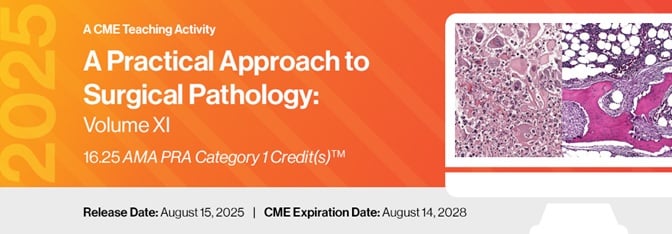
2025 A Practical Approach to Surgical Pathology: Volume XI – A Video CME Teaching Activity
Program
| An Approach to Spindle Cell Tumors of Soft Tissue
John R. Goldblum, M.D. |
1.00 Hrs |
| Approach to Adequacy Assessment in Endobronchial Ultrasound Sampling – Case Illustrations with Cyto-Histo Correlations
Rema (Rao) Chaari, MBBS |
1.00 Hrs |
| Steatotic Liver Disease – Beyond NASH/MASH/MASLD
John Hart, M.D. |
1.00 Hrs |
| Non-Neoplastic Orthopedic Pathology
G. Petur Nielsen, M.D. |
1.00 Hrs |
| Navigating Mucinous Neoplasms of the Appendix
Erika Hissong, M.D. |
1.00 Hrs |
| Small Glandular Proliferations of the Breast and Mimics of Carcinoma
Mara H. Rendi, M.D., Ph.D. |
1.00 Hrs |
| Approach to Indeterminate Thyroid Cytology with Updates on the Most Recent Bethesda Classification System
Rema (Rao) Chaari, MBBS |
1.00 Hrs |
| Autoimmune Hepatitis – There Is a Lot to Talk About
John Hart, M.D. |
0.50 Hrs |
| What’s New in Fat
G. Petur Nielsen, M.D. |
1.00 Hrs |
| Common Morphologic Patterns in Soft Tissue Tumors
John R. Goldblum, M.D. |
1.75 Hrs |
| Infections of the Gastrointestinal Tract and Their Mimics: A Case-Based Review
Erika Hissong, M.D. |
0.75 Hrs |
| Tenosynovial Tumors
G. Petur Nielsen, M.D. |
0.75 Hrs |
| Cholestatic Liver Disease – A Jaundiced View
John Hart, M.D. |
0.75 Hrs |
| Daily Difficulties in Breast Pathology and How to Overcome Them
Mara H. Rendi, M.D., Ph.D. |
1.00 Hrs |
| The Basics of Molecular Testing in Gastrointestinal Neoplasms
Erika Hissong, M.D. |
0.75 Hrs |
| Approach to EUS-FNA Cytology for Pancreatic Lesions – Potential Pitfalls and Challenges
Rema (Rao) Chaari, MBBS |
1.00 Hrs |
| Breast Ancillary Study Reporting: ER/PR/HER2 Everything You Need to Know About ER/PR/HER2, Ki-67, and PD-L1 Immunohistochemistry (Including How to Report It)
Mara H. Rendi, M.D., Ph.D. |
1.00 Hrs |
About This CME Teaching Activity
This CME teaching activity This seminar has been designed to provide a comprehensive overview of some of the most common areas of diagnostic difficulty encountered by practicing surgical pathologists in the areas of breast, orthopedic, gastrointestinal, and soft tissue pathology, as well as particular aspects of cytopathology. This course provides extensive details of some of the most important diagnostic features which allow pathologists to make accurate diagnoses in each of these subspecialized areas, as well as how to assess essential diagnostic clues and avoid the most common diagnostic pitfalls. In each lecture, there is a thorough discussion on the use of ancillary diagnostic techniques, including both immunohistochemistry and molecular diagnostics.
Target Audience
This CME activity is primarily intended and designed to educate practicing pathologists.
Educational Objectives
At the completion of this CME teaching activity, you should be able to:
- Recognize the most common spindle cell tumors of soft tissue and identify appropriate use of both immunohistochemistry and molecular diagnostics in arriving at a diagnosis.
- Identify the most common morphologic patterns in soft tissue tumors.
- Discuss a practical approach to adequacy assessment in endobronchial ultrasound sampling.
- Recognize the most common entities in non-neoplastic orthopedic specimens.
- Define the most common appendiceal mucinous neoplasms and the most common diagnostic pitfalls.
- Recognize the various patterns of small glandular proliferations of the breast.
- Become familiar with an approach to diagnostic difficulties with thyroid pathology as well as the most recent updates in the Bethesda classification system.
- Describe the most common but most useful diagnostic features in recognizing autoimmune hepatitis.
- Describe the most common lipomatous neoplasms encountered by surgical pathologists.
Be the first to review “2025 A Practical Approach to Surgical Pathology Volume XI (Videos)”
Related products
*HOT books
Solomon and O’Brien’s Pediatric Skills for Occupational Therapy Assistants, 6th edition (EPUB)

*HOT books
Robotic-Assisted Eye Surgery: Advances, Challenges, and Breakthroughs (Original PDF from Publisher)

Reviews
There are no reviews yet.