
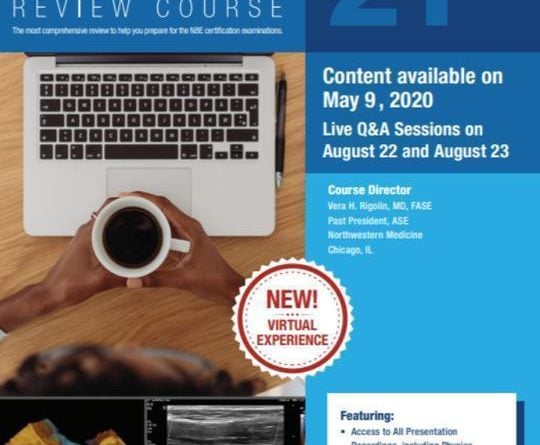

After much consideration, the decision has been made to transition the live 2020 ASCeXAM/ReASCE Review Course to be offered online as a Virtual Experience.
This course will be available starting on Saturday, May 9 and will offer access to recordings and PDF slides of all scheduled presentations, including physics. This is not a live streamed event.
There will be a live Q&A webinar on Saturday, August 22 and Sunday, August 23, from 10:00 AM – 12:00 PM Eastern Time, where faculty will answer questions from registrants. Questions can be submitted in advance using a form that will be emailed to all registrants when the recordings are available. Faculty will also answer questions submitted live during the event. The live Q&A sessions will be recorded and available to registrants in the virtual library that you will have access to for three years.
ASCeXAM/ReASCE Review Course Learning Objectives
Upon completion of this course, participants should be better able to:
- Explain the essential physical principles of cardiac ultrasound.
- Recognize common ultrasound artifacts and their genesis.
- Estimate systolic function using standard M-mode and 2D echocardiography, as well as newer modalities such as strain imaging and 3D echocardiography.
- Identify and quantitate valvular heart disease severity.
- Describe the application of Doppler in the assessment of hemodynamics and diastolic function.
- Perform clinically relevant calculations of valve areas and intracardiac pressures.
- Explain proven techniques for interpreting stress echocardiographic examinations.
- Differentiate features of cardiac tamponade, constrictive pericarditis and restrictive cardiomyopathy.
- List appropriate applications of echocardiography.
- Recognize newer applications of echocardiography such as myocardial contrast.
Topics And Speakers:
Aortic Regurgitation, Aortic Prosthesis, Cardiac Masses, Myocardial Infarction, and Interventional Echocardiography
- Cardiac Masses
- Complications of Myocardial Infarction
- Evaluation of Aortic Prosthesis
- Primer of Interventional Echocardiography
- Quantitation of Aortic Regurgitation
Contrast, Congenital Heart Disease
- Different Variants of Aortic Stenosis
- Echocardiographic Evaluation of Mitral Valve Prostheses
- Echocardiography in Systemic Disease
- How to Assess Aortic Stenosis New Guidelines 1
- How to Assess Aortic Stenosis New Guidelines
- Hypertrophic Cardiomyopathy
- Which Formulas Should I Know For the Exam
- Board Review Questions Aortic Stenosis, Mankad
- Board Review Questions Aortic Stenosis, Rigolin
- Board Review Questions Mitral Valve Prostheses, Lester
- Board Review Questions Systemic Disease, Mankad
Physics, Knobology, Artifacts, Right Ventricular Function
- Artifacts Theory and Illustrative Examples
- Basic Ultrasound Physics
- Concepts of Imaging and Knobology
- Evaluation of the Right Ventricle
- Fundamentals in Doppler Physics
- More formulas I Need to Know for the Exam
- Tricuspid and Pulmonary Valve Disease New Guidelines
- Board Review Questions Artifacts, Keane
- Board Review Questions Doppler Physics, Zagzebski
- Board Review Questions ImagingKnobology, Patil
- Board Review Questions Right Ventricle, Rigolin
- Board Review Questions TricuspidPulmonary Valve Disease, Addetia
- Board Review Questions Ultrasound Physics, Zagzebski
Spectral Doppler, Deformation, Stress Echo, Mitral Stenosis, Mitral Valve Disease
- Deformation Imaging
- Degenerative Mitral Valve Disease
- Functional Mitral Valve Disease
- Mitral Stenosis
- Quantification of Mitral Regurgitation New Guidelines
- Spectral Doppler and M-Mode Echo Cases
- Stress Echocardiography Theoretical and Practical Considerations
Be the first to review “ASCeXAM/ReASCE Review Course: Virtual Experience 2020 (Videos)”
Related products
*HOT books
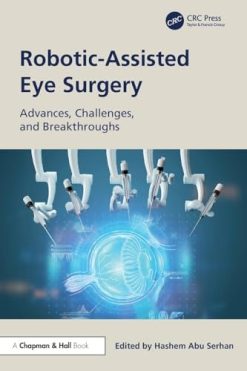
Robotic-Assisted Eye Surgery: Advances, Challenges, and Breakthroughs (Original PDF from Publisher)



Reviews
There are no reviews yet.